Research Project 1: Bee Hotels | How Effective Are They?
Posted in:
Conservation, Ecology, Invertebrates, Research, Urban Ecosystems
Date posted: 1 January 2023
As Alar Ecology winds down its commercial work, a number of interesting research projects are now taking off.
Many species of Hymenoptera live in hollows and crevices and do not excavate their own nest sites. Instead, they utilise existing holes. The use of bee ‘hotels’ has the potential to boost local populations of solitary bees, many of which are in steep decline. Many mitigation schemes advocate the use of bee hotels, but there is a scarcity of published information to show that they actually work. And a detailed evidence base to inform how bee hotels should be deployed is lacking, most ecologists relying on ‘common sense’.
This project looks at the effectiveness of bee hotels. It addresses five key questions:
- Do they work?
- What direction should they face?
- How high (off the surrounding terrain) should they be positioned?
- Do mason bees and leaf-cutter bees have different requirements?
- And are bees deterred by anti predator devices?
The two images below show: a leaf-cutter bee putting the final touches to a nesting cell; and completed nesting cells in which both green leaves and flower petals have been used.


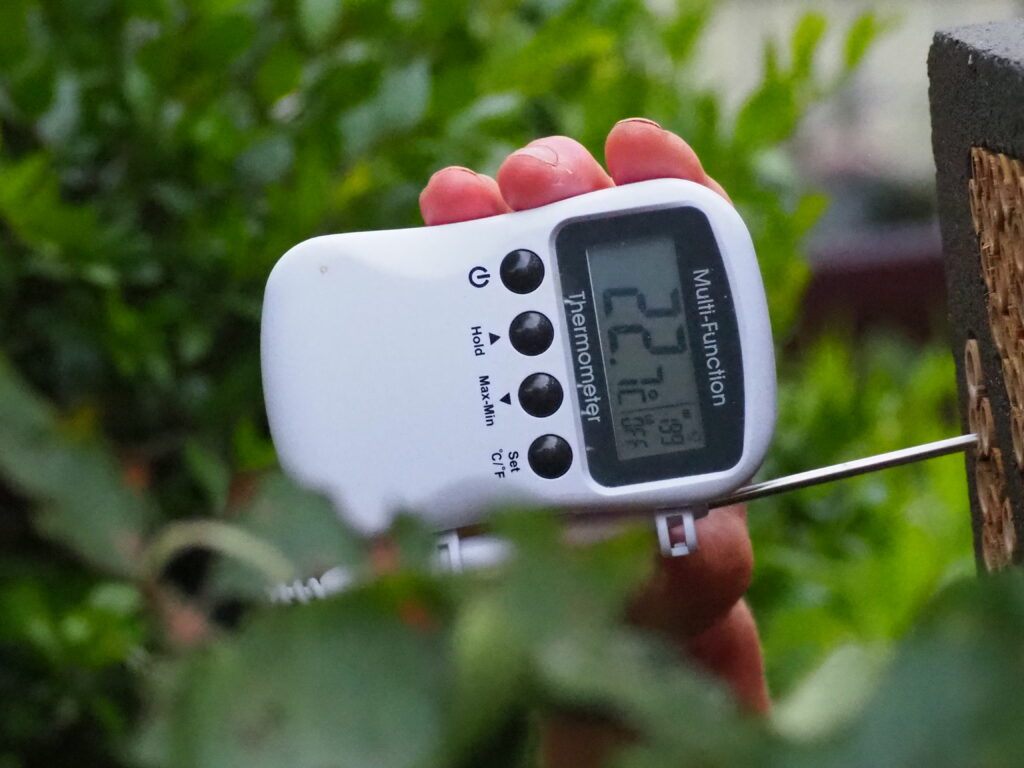
The image below shows how the temperature inside of the bee hotel is being monitored.
Finally, The video below shows the thermal properties of a stone/concrete ‘bee hotel’, much appreciated by a solitary bee that checks in.